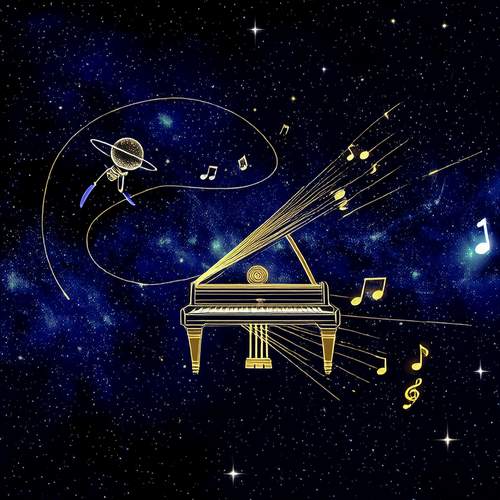
The universe is not silent. While we often think of space as a vast, empty void, it is in fact filled with a symphony of electromagnetic waves that have been traveling across the cosmos for billions of years. These waves, invisible to the human eye, carry with them the secrets of distant stars, galaxies, and even the remnants of the Big Bang itself. Scientists and musicians alike have begun to explore how these cosmic signals can be translated into sound, creating what is now known as "cosmic electromagnetic wave music." This emerging field blends astrophysics with artistry, offering a new way to experience the universe.
The Science Behind Cosmic Sounds
Electromagnetic waves span a wide spectrum, from radio waves to gamma rays. Among these, radio waves are particularly significant for cosmic music because they can be detected and converted into audible sound. Radio telescopes, such as the famous Arecibo Observatory or the more recent Square Kilometre Array, capture these waves from celestial objects like pulsars, quasars, and even the cosmic microwave background radiation—the faint afterglow of the Big Bang. By processing these signals, scientists can shift their frequencies into the range of human hearing, revealing rhythms and patterns that would otherwise go unnoticed.
For example, pulsars—rapidly rotating neutron stars—emit beams of radio waves that sweep across space like cosmic lighthouses. When these pulses are converted into sound, they produce a rhythmic ticking, almost like a metronome. Similarly, the chaotic radio emissions from Jupiter’s magnetosphere create eerie, otherworldly noises that sound like something from a science fiction film. These sounds are not just curiosities; they provide valuable insights into the physical processes occurring in these distant regions of space.
From Data to Music: The Artistic Interpretation
While the raw conversion of electromagnetic waves into sound can produce fascinating results, many artists and composers take this a step further by using the data as inspiration for original musical compositions. By assigning musical notes or instruments to specific frequencies or patterns, they create pieces that are both scientifically accurate and emotionally evocative. This process is not unlike how a painter might interpret a landscape, using creativity to enhance the beauty of the natural world.
One notable example is the work of composer Domenico Vicinanza, who used data from the European Space Agency’s Planck satellite to create a musical representation of the cosmic microwave background. The result was a haunting, ethereal piece that captures the faint echoes of the universe’s birth. Similarly, NASA has released "sonifications" of data from the Chandra X-ray Observatory, transforming the X-ray emissions of distant galaxies into immersive soundscapes. These projects bridge the gap between science and art, allowing listeners to "hear" the universe in a way that is both educational and deeply moving.
The Cultural and Philosophical Impact
Cosmic electromagnetic wave music is more than just a novelty; it challenges our perception of the universe and our place within it. By translating the invisible into the audible, it makes the vastness of space feel more immediate and intimate. This has profound implications for how we understand our connection to the cosmos. For centuries, humans have looked to the stars for inspiration, but now we can listen to them as well.
Moreover, this fusion of science and art raises philosophical questions about the nature of reality and creativity. Are these cosmic sounds "music" in the traditional sense, or are they simply data rendered in auditory form? Does the act of interpreting them as music impose human meaning onto something inherently impersonal? These questions do not have easy answers, but they invite us to think more deeply about the relationship between the universe and the human experience.
The Future of Cosmic Music
As technology advances, the possibilities for cosmic electromagnetic wave music will only expand. New telescopes and more sophisticated data-processing techniques will allow us to capture even fainter and more distant signals. At the same time, advancements in audio technology will enable richer and more immersive musical interpretations. We may soon see entire symphonies composed from the sounds of the cosmos, or virtual reality experiences that let us "travel" through space by following its electromagnetic melodies.
This field also has the potential to inspire a new generation of scientists and artists. By demonstrating that the universe is not just something to be observed but also to be heard, it encourages a more holistic approach to exploration. Whether you are an astrophysicist, a musician, or simply someone who marvels at the night sky, cosmic electromagnetic wave music offers a fresh and captivating way to engage with the wonders of the cosmos.
In the end, the universe’s electromagnetic symphony reminds us that we are part of something much larger than ourselves. It is a humbling and awe-inspiring realization—one that resonates not just in our ears, but in our souls.

By /May 30, 2025

By /May 30, 2025
By /May 30, 2025

By /May 30, 2025

By /May 30, 2025

By /May 30, 2025

By /May 30, 2025

By /May 30, 2025

By /May 30, 2025

By /May 30, 2025

By /May 30, 2025

By /May 30, 2025

By /May 30, 2025

By /May 30, 2025

By /May 30, 2025

By /May 30, 2025

By /May 30, 2025

By /May 30, 2025

By /May 30, 2025

By /May 30, 2025