The oral tradition of India stands as one of the most vibrant and enduring cultural phenomena in human history. Passed down through generations, these narratives, songs, and chants have shaped the collective memory of a civilization that spans millennia. Unlike written texts, which are bound by the constraints of literacy and preservation, India's oral traditions thrive in the living voices of storytellers, bards, and everyday people. They are not merely relics of the past but dynamic expressions that continue to evolve, reflecting the ever-changing tapestry of Indian society.
The roots of India's oral tradition run deep, intertwining with the very fabric of its spiritual and social life. Long before the advent of writing, the Vedas—the oldest sacred texts of Hinduism—were transmitted orally by Brahmin priests. The precision with which these hymns were preserved over centuries is a testament to the sophistication of India's mnemonic techniques. The rhythmic cadence of Sanskrit verses, coupled with intricate tonal patterns, ensured that the sacred knowledge remained unaltered. Even today, Vedic chanting is recognized by UNESCO as an intangible cultural heritage, a living bridge to an ancient past.
Beyond the realm of the sacred, India's oral tradition encompasses a staggering diversity of folk tales, epics, and ballads. The Panchatantra, a collection of animal fables, has traveled across continents, influencing storytelling traditions from Persia to Europe. Similarly, the Jataka tales, which recount the previous lives of the Buddha, have been retold in countless regional dialects, each version adding local flavors and moral nuances. These stories were never meant to be frozen in time; they were designed to adapt, to resonate with new audiences while retaining their core wisdom.
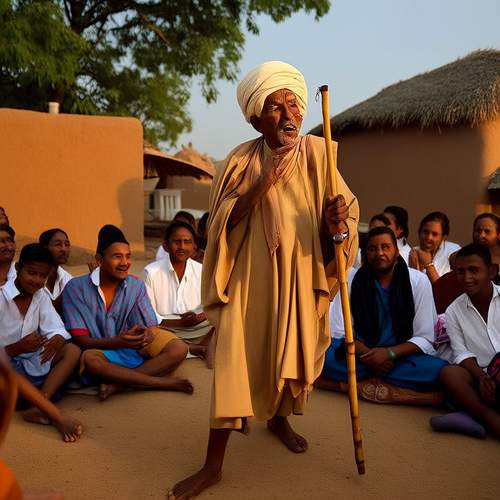
The role of the storyteller in Indian society cannot be overstated. In villages, the Kathakar (narrator) would gather audiences under banyan trees, spinning tales of gods and demons, love and betrayal. The performative aspect of these sessions—complete with gestures, facial expressions, and improvisations—turned storytelling into a communal experience. The epics of the Mahabharata and Ramayana were not just recited but enacted, with listeners often interjecting, questioning, or even challenging the narrator. This interactive dynamic blurred the line between performer and audience, making oral tradition a participatory art form.
Music and oral tradition are inseparable in India. From the devotional bhajans of North India to the villu paatu (bow-song) of Tamil Nadu, melodies serve as vessels for cultural memory. The Bauls of Bengal, wandering minstrels who sing of divine love and human folly, embody the syncretic spirit of India's oral heritage. Their songs, often composed spontaneously, draw from Hindu, Sufi, and folk traditions, refusing to acknowledge rigid religious boundaries. In this way, oral traditions have historically been a force for unity in a land of bewildering diversity.
The challenge of modernity has cast both shadows and light on India's oral traditions. On one hand, urbanization and digital media have eroded traditional storytelling spaces. The village square, once alive with the sound of shared narratives, now competes with smartphones and television screens. Yet, there are also signs of resilience and reinvention. Contemporary artists are blending oral techniques with new media, creating podcasts that mimic the cadence of folk tales or YouTube channels dedicated to regional storytelling styles. The essence of the oral tradition—its adaptability—may well be its salvation in the digital age.
Perhaps the most remarkable aspect of India's oral tradition is its ability to hold contradictions. It preserves the ancient while embracing the new, maintains sacred purity while celebrating folk irreverence, and upholds community bonds while nurturing individual creativity. In a country where hundreds of languages coexist, oral traditions have been both a mirror of diversity and a thread of continuity. They remind us that before stories were written, they were breathed into life—and in India, that breath has never faltered.

By /May 30, 2025

By /May 30, 2025

By /May 30, 2025

By /May 30, 2025

By /May 30, 2025
By /May 30, 2025
By /May 30, 2025
By /May 30, 2025

By /May 30, 2025
By /May 30, 2025
By /May 30, 2025
By /May 30, 2025
By /May 30, 2025
By /May 30, 2025
By /May 30, 2025

By /May 30, 2025

By /May 30, 2025

By /May 30, 2025

By /May 30, 2025

By /May 30, 2025